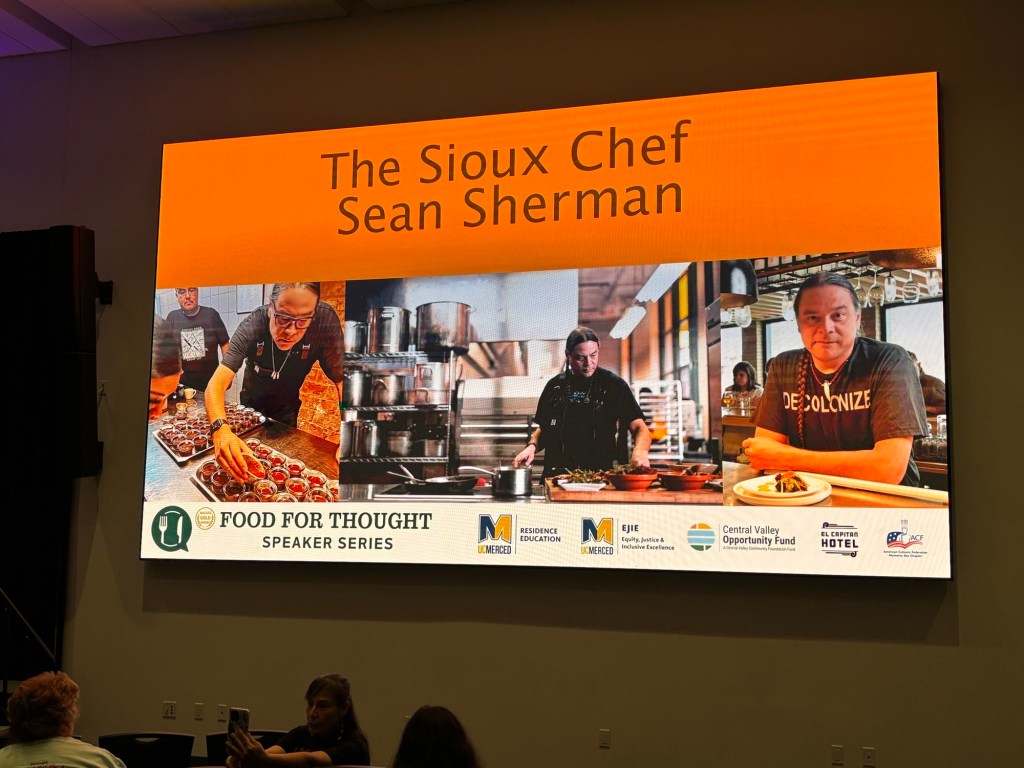
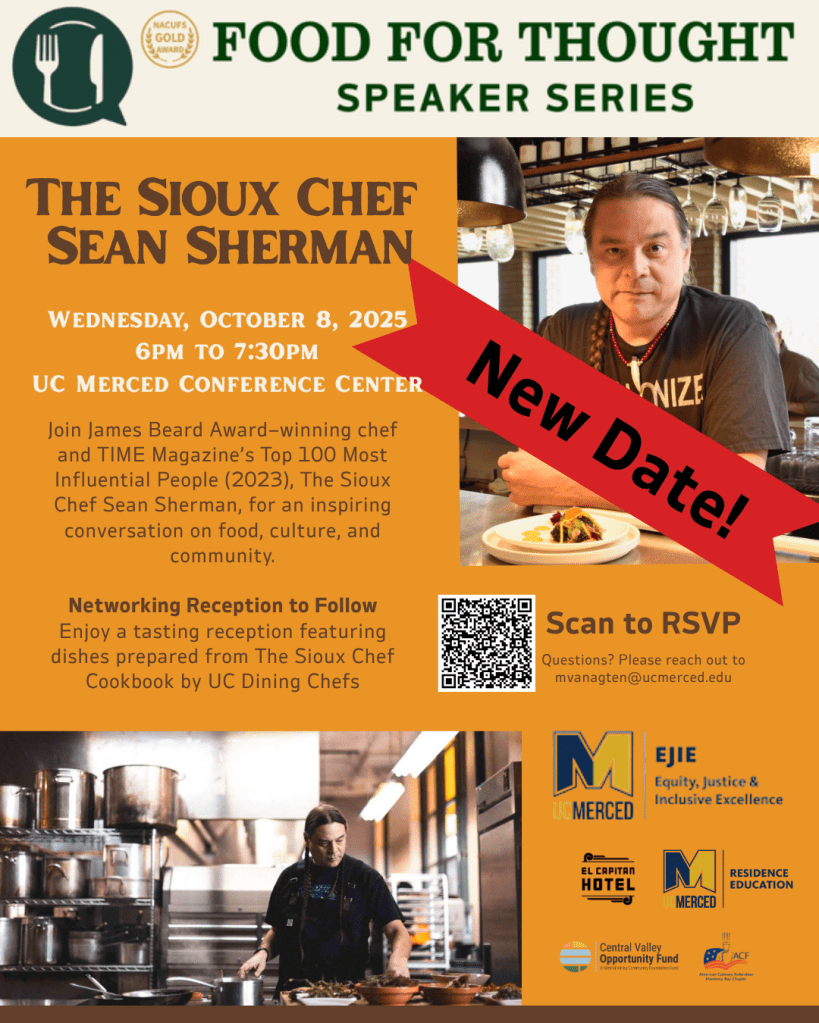
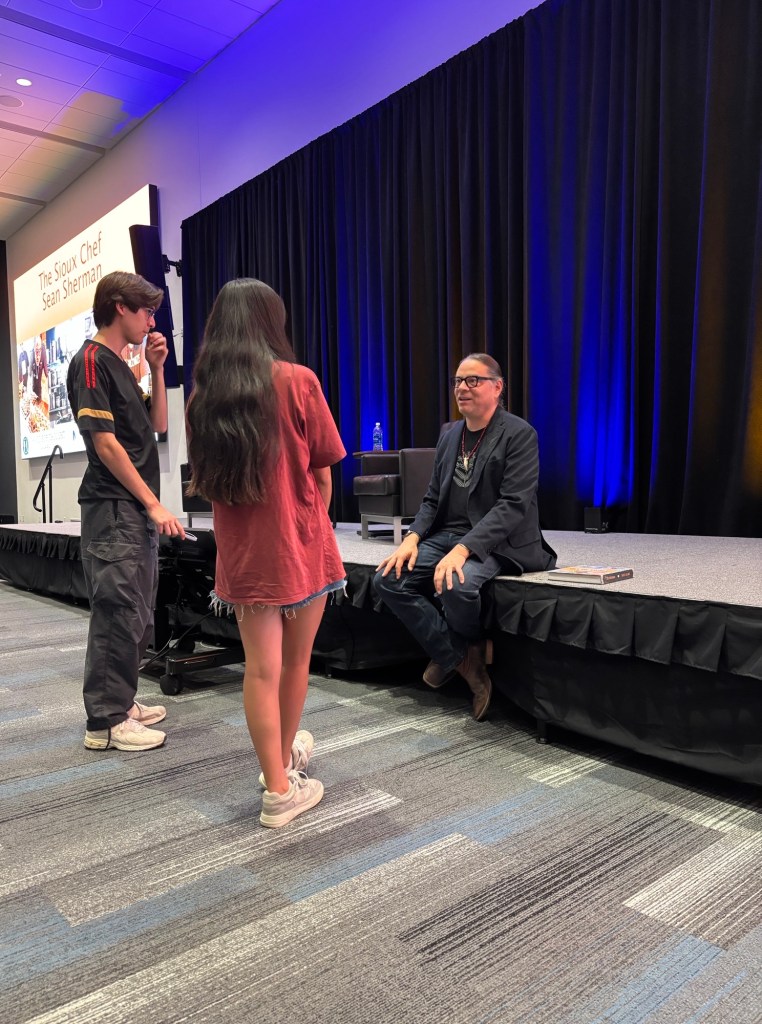
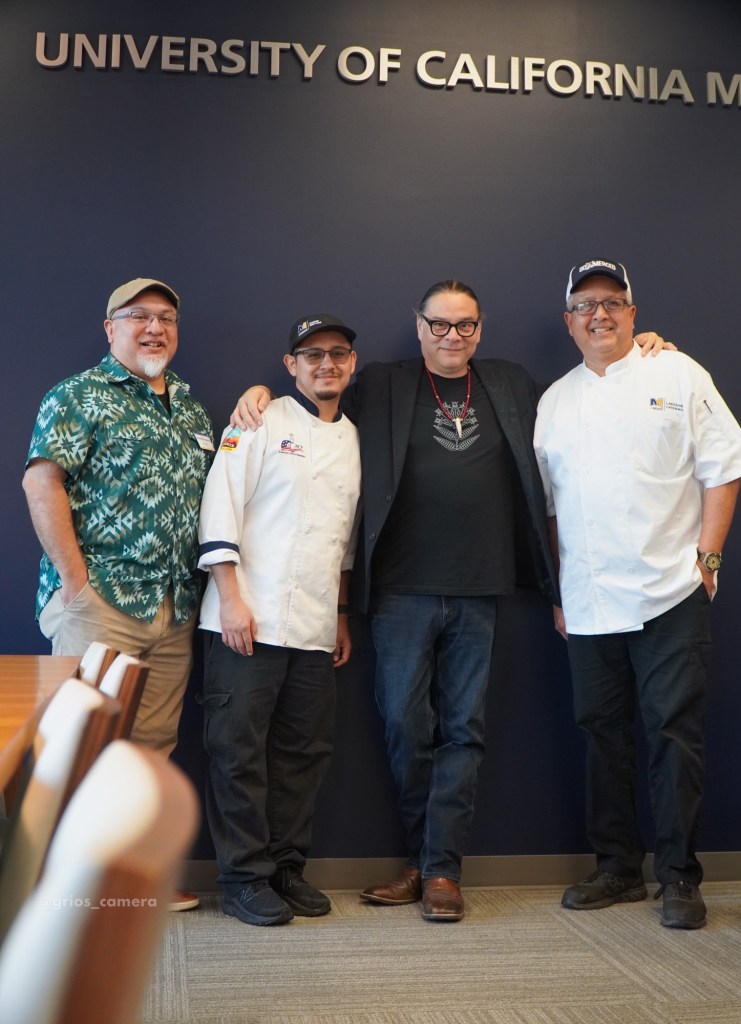
Last week, UC Merced Dining had the privilege of welcoming Chef Sean Sherman, founder of The Sioux Chef and co-founder of the nonprofit NĀTIFS (North American Traditional Indigenous Food Systems), for an inspiring evening that blended food, culture, and community. A member of the Oglala Lakota Nation, Chef Sherman is internationally recognized for his work to revitalize Indigenous foodways and reconnect people to pre-colonial ingredients and traditions.
Revitalizing a Food System Rooted in Place
Through his award-winning Minneapolis restaurant Owamni, Chef Sherman has shown that food can be both a path to cultural healing and environmental sustainability. His first book, The Sioux Chef’s Indigenous Kitchen, earned the James Beard Award for Best American Cookbook and became a landmark in reclaiming Native cuisine.
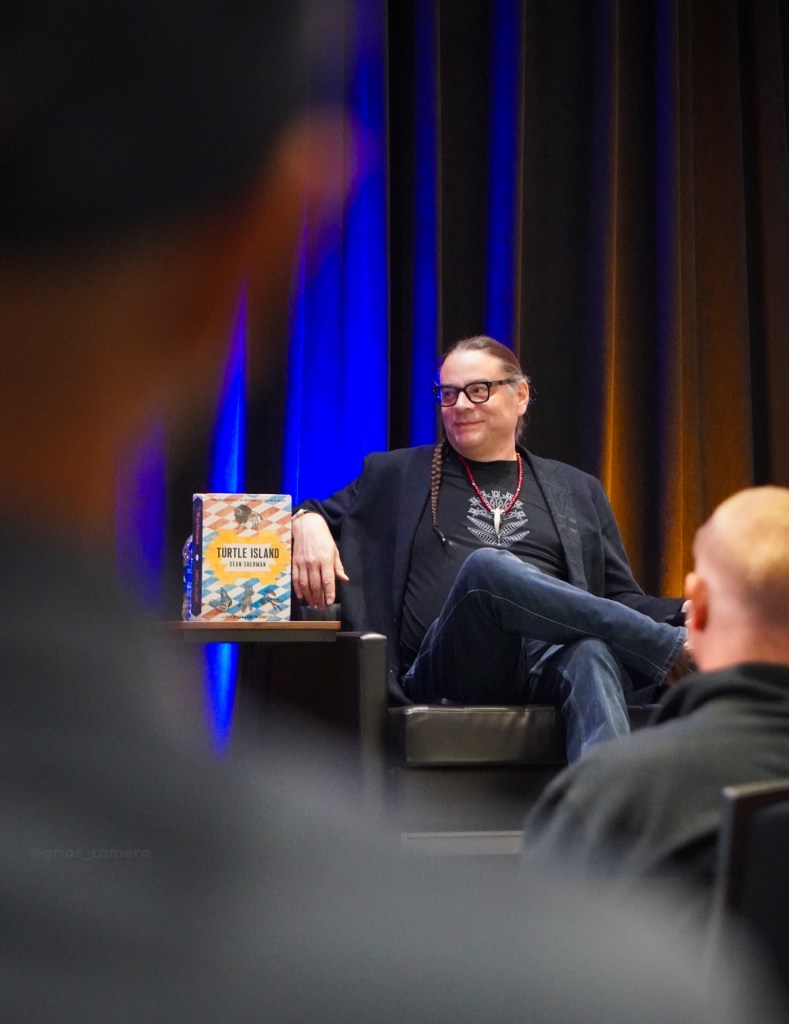
This year, he released his highly anticipated new cookbook, Turtle Island: Foods and Traditions of the Indigenous Peoples of North America, which expands his mission across the continent. The book is as much a celebration of Indigenous identity as it is a call to action—urging chefs, educators, and communities to embrace the wisdom of Native food systems built on respect, seasonality, and sustainability.
An Evening of Song, Story, and Shared Purpose
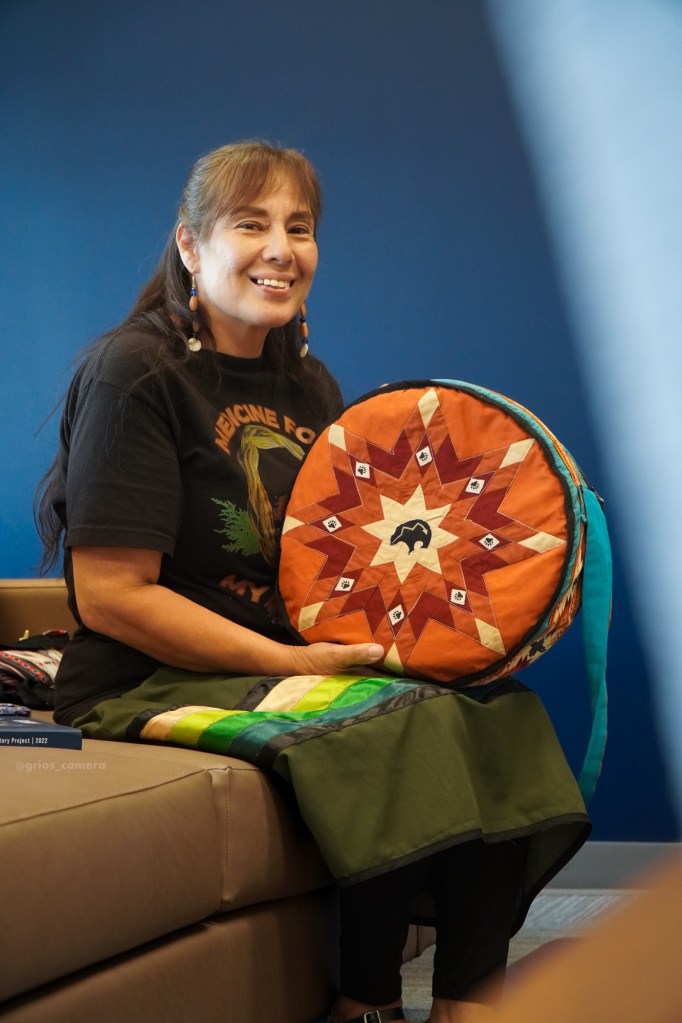
The night began with a moving performance by Medicine for My Sisters, whose voices filled the ballroom with songs of strength, gratitude, and connection. Their presence reminded everyone that Indigenous food is inseparable from land, spirit, and ceremony.
The discussion that followed—moderated by Anthony Pangelina—was both intimate and insightful. Anthony guided the conversation beautifully, drawing out Chef Sherman’s reflections on food sovereignty, his journey from the Great Plains to global recognition, and the collective responsibility we share in supporting Indigenous producers and educators.
A Culinary Tribute by Our Chef Team
After the talk, guests were invited to enjoy a reception featuring dishes inspired by Chef Sherman’s philosophy and recipes. Our UC Merced chef team took great care to represent his approach with authenticity and creativity—crafting a menu that celebrated the flavors and principles of Indigenous cuisine. Highlights included:
- Cedar-infused grains with foraged herb aromatics
- Three Sisters mash of corn, beans, and squash
- Maple-roasted root vegetables with wild sage
- Bison braised in juniper and sumac, a nod to pre-colonial ingredients
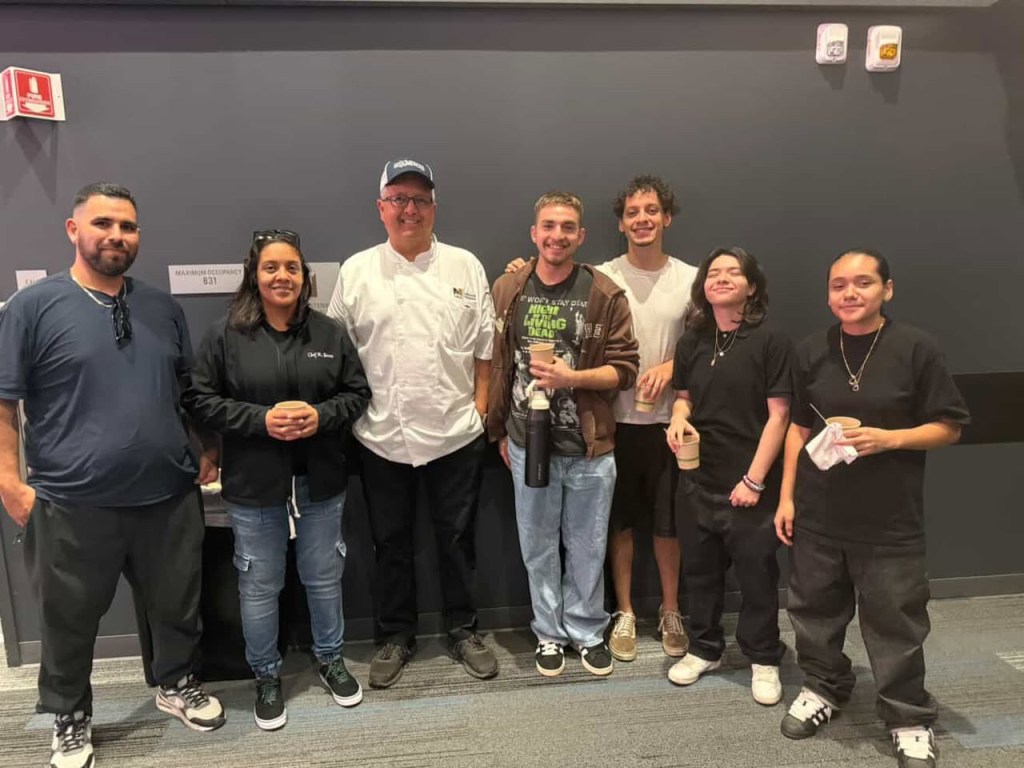
Their execution was flawless, and the care behind each dish reflected the respect our team has for the traditions Chef Sherman uplifts.
Here is one of Chef Sean’s recipes that the team prepared.
Three Sisters Bowl with Hominy, Beans and Squash
By Sean Sherman
(Yield: 4 servings) LTBB Official Website
Ingredients
- ½ cup dried hominy OR use 2 cups of canned hominy
- ½ cup dried brown tepary beans OR substitute navy or great northern beans
- 1 small unpeeled acorn squash (about 1¼ pounds), halved, seeds & membranes removed, then cut into 1-inch chunks
- 3 Tbsp sunflower oil
- Coarse sea salt
- 1 small yellow onion, halved and thinly sliced
- 1 Tbsp New Mexico Hatch chile powder or any mild smoked red chile powder
- 2 tsp chopped fresh sage
- Smoked sea salt
- ½ cup chopped dark greens (such as dandelion greens, kale or spinach)
Preparation
- Place the hominy and the beans in separate medium bowls, cover each with 4 inches of water, and soak overnight at room temperature.
- About 3 hours before serving, drain the hominy and beans and place each in separate 3-4 quart pots. Add enough cool water to cover by 4 inches, bring to a boil, then reduce heat and simmer gently (skimming foam) until tender, about 1½-2 hours. Reserve about 2/3 cup of each cooking liquid for a total of ~1⅓ cups of liquid. Drain hominy and beans and set aside.
- Meanwhile, preheat oven to 425 °F. On a parchment-lined rimmed baking sheet, toss the squash with 1 Tbsp oil and a pinch of coarse sea salt. Arrange in an even layer and roast until golden and tender, about 35-45 minutes, stirring halfway through.
- In a large skillet, heat the remaining 2 Tbsp oil over medium-high. Add the onion, chile powder, sage and a generous pinch of smoked salt. Cook, stirring occasionally, until the onion is tender (≈5-8 minutes). Add the reserved ~1⅓ cups of cooking liquid and bring to a simmer.
- Add the cooked hominy and beans to the skillet, then stir in the roasted squash and greens. Season to taste with coarse sea salt and serve.
Gratitude and Reflection
The next morning, I received several messages from attendees—some who found my number and reached out just to share how deeply the event had touched them. Their words meant a lot. They spoke of feeling seen, inspired, and grateful for a space where food and culture were honored together.
Moments like this remind me why we do what we do at UC Merced Dining: food is not just sustenance—it’s story, identity, and bridge-building.
A heartfelt thank-you to Chef Sean Sherman for sharing his wisdom and generosity, to Anthony Pangelina for guiding a thoughtful dialogue, to Medicine for My Sisters for grounding the evening in spirit, and to our incredible chef team for bringing it all to life on the plate.
Continuing the Journey
Chef Sherman’s visit reaffirmed our commitment to using food as a platform for education and inclusion. We look forward to continuing to highlight Indigenous, local, and culturally rooted cuisines that remind us where our food—and our shared humanity—comes from.


 Culinary Connections